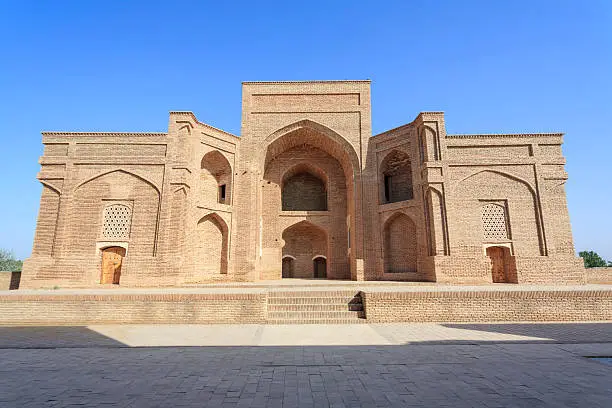
Khorezm Region
Heir to ancient Khwarezm, the Khorezm region is home to Khiva and its UNESCO-listed medieval monuments, as well as some twenty fortresses scattered across the Uzbek steppe.
The Khorezm region occupies the northwestern corner of Uzbekistan, in the Amu Darya delta, at the edge of the Karakum desert. Heir to ancient Khwarezm, one of Central Asia's oldest civilizations, it is home to Khiva—a museum-city listed by UNESCO—and a constellation of thousand-year-old fortresses scattered across the steppe. Between preserved medieval architecture, living craft traditions and desert landscapes, Khorezm offers an immersion into a palpable past.
Practical information at a glance
- Capital: Urgench, connected by domestic flights from Tashkent and Samarkand.
- Access to Khiva: approximately 35 km from Urgench, reachable by shared taxi or private taxi.
- Best time to visit: April–June and September–October (moderate heat; summer regularly exceeds 40 °C).
- Recommended duration: 2 to 3 days for Khiva + 1 day for surrounding fortresses.
- Currency: Uzbek som; bring cash, as ATMs are rare outside Urgench.
- Dress code: Covering clothes recommended in mosques and madrasas.
What to see
The heart of the region is Khiva, whose historic center Itchan Kala forms an intact fortified city. Around it, the steppe holds some twenty Khorezm fortresses (kala) dating from the 1st to 8th centuries: Ayaz-Kala, Toprak-Kala, Kyzyl-Kala. The Amu Darya delta traces a network of canals and farmland that contrasts with the sandy expanses of the nearby Karakum.
History and context
Khwarezm is attested from the 1st millennium BCE as one of Central Asia's earliest state entities. The region was successively Achaemenid, Greek, Parthian, then the capital of an empire stretching from Iran to India in the 13th century, before being devastated by Genghis Khan in 1221. It subsequently experienced a renaissance under the Timurids and the khans of Khiva, who ruled until the Russian conquest of 1873. This layered heritage explains the exceptional density of monuments across a relatively restricted territory.
Highlights of the visit
Itchan Kala, Khiva
The inner city of Khiva, inscribed as a World Heritage Site by UNESCO in 1990, concentrates mosques, madrasas, minarets and palaces within an area of less than one square kilometer. The Kalta Minor tower, with its unfinished turquoise tilework, and the Islam-Khoja minaret, the highest in the region, are its most immediate visual landmarks.
Fortresses of the steppe
Ayaz-Kala offers a breathtaking panorama of the desert from its rammed-earth ramparts. Toprak-Kala, an ancient royal capital of the 3rd century, preserves remnants of frescoes and sculptures. These sites are ideally visited as a day excursion from Khiva, preferably with a local guide familiar with the tracks.
Khorezm craftsmanship
The region is renowned for its suzani (embroidery on silk or cotton), ceramics with geometric motifs and wood carvings. The workshops of Itchan Kala allow you to observe artisans at work and purchase directly from producers.
Etiquette and visiting rules
- In active mosques and madrasas, cover shoulders and knees; women should cover the head.
- Remove your shoes before entering prayer spaces.
- Ask permission before photographing residents, particularly women.
- Some fortress areas are fragile: stay on marked paths.
Photography tips
The golden light at sunrise and sunset enhances the turquoise tiles of Itchan Kala. For the fortresses, the golden hour in the evening reveals the texture of rammed earth. Avoid midday in summer: the light is harsh and the heat exhausting. A wide-angle lens is useful in Khiva's narrow lanes.
Location and access
Khorezm is accessible by flight from Tashkent to Urgench airport. Train also connects Tashkent to Urgench, but the journey is long (approximately 16 hours). From Urgench, shared taxis regularly serve Khiva. Fortresses require a private vehicle or organized excursion. PMR accessibility is limited at historic sites due to paving and stairs.
Nearby
- Itchan Kala, Khiva — UNESCO-listed medieval fortified city, historic heart of the region.
- Ayaz-Kala — rammed-earth fortress overlooking the desert, dating from the 1st century.
- Toprak-Kala — ancient Khorezm royal capital with remnants of frescoes.
- Aral Sea — several hours to the north, a major ecological remnant accessible from Moynaq (Uzbek side).
Frequently asked questions
Spring (April–June) and autumn (September–October) offer pleasant temperatures. Summer regularly exceeds 40 °C, making visits to the fortresses arduous. Winter is cold and some accommodations reduce operations.
British nationals enjoy visa-free access for tourist stays. Check current conditions with your embassy or consulate before departure, as regulations may change.
Yes, but distances are considerable. Flying between Urgench and Samarkand or Tashkent is the fastest option. A 10 to 14-day itinerary allows you to cover all three destinations without rushing.
The fortresses are not served by public transport. Rent a private taxi from Khiva or book an organized excursion. A local guide familiar with the tracks is recommended, especially for the most remote sites.
Photography is generally permitted in outdoor areas. Some museums and places of worship impose a photography fee or prohibit photography indoors. Check at the entrance of each site.
Allow 2 to 3 days to explore Khiva thoroughly, and one extra day for an excursion to the fortresses. Four days in total allows a complete visit at a comfortable pace.