Samarkand and Shakhrisabz
The heart of Timurid Uzbekistan: three madrasas aligned on the Registan, the Shah-i-Zinda necropolis at dawn, and the Ak-Saray ruins in Shakhrisabz south of Takhtakaracha Pass.
Samarkand stretches across the Zeravshan valley at 700 meters elevation, framed to the south by the foothills of the Zerafshan range that herald the Pamir. This crossroads position explains its historical role: a major waypoint on the Silk Road between China and the Mediterranean, capital of Tamerlane's empire in the 14th century, then an intellectual center under his grandson Ulugh Beg, an astronomer before becoming sovereign. Today's city has roughly 550,000 inhabitants, predominantly Tajik-speakers, which sets it apart linguistically from the rest of Uzbekistan's Uzbek-speaking regions.
The monumental heart spans just a few square kilometers. Registan Square lines up three madrasas built between 1417 and 1660: Ulugh Beg, Sher-Dor recognizable by its stylized sun-tigers on the façade, and Tilla-Kari whose prayer hall is entirely covered in gold leaf. A ten-minute walk away, the Bibi-Khanum Mosque, commissioned by Tamerlane after his Indian campaign in 1399, preserves a 35-meter-high portal. The Shah-i-Zinda necropolis, an alley lined with 14th and 15th-century mausoleums, can be explored in an hour; we recommend arriving around 7am, before the tour groups, when the low-angle light brings out the blue and turquoise mosaics. The Gour-Emir mausoleum, where Tamerlane is buried beneath a slab of green jade, completes this Timurid circuit.
Beyond monuments, Samarkand retains neighborhood life around the Siab Bazaar, the great food market adjoining Bibi-Khanum. Here you'll find round loaves stamped with a seal, non, a local specialty that keeps for several weeks in its Samarkand version, along with dried apricots, Khorasan raisins, and Fergana walnuts. About ten kilometers northeast, the village of Konigil still houses several workshops producing silk paper using traditional techniques from mulberry bark, a craft revived in the 1990s after decades of dormancy.
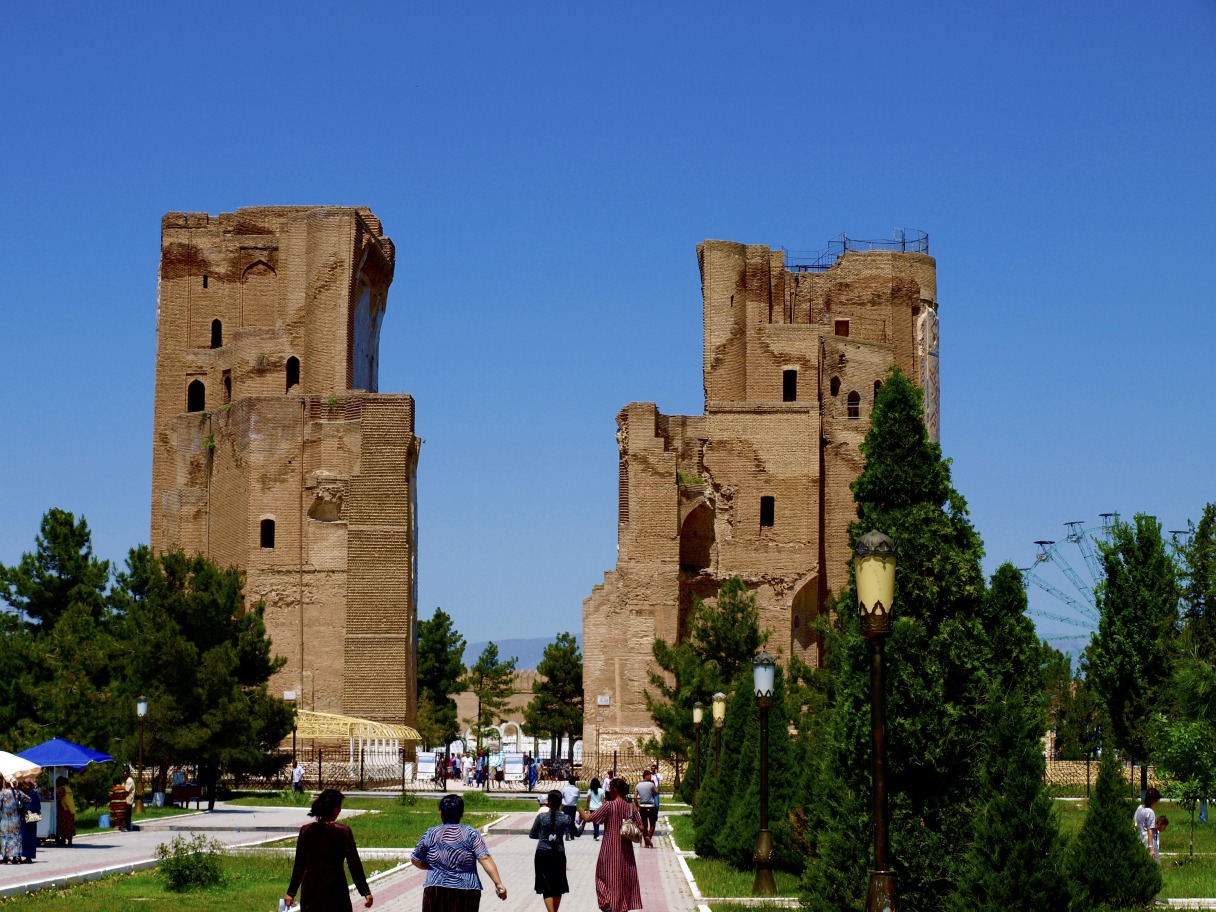
Two hours' drive south, crossing Takhtakaracha Pass at 1,788 meters, you enter the Kashkadarya valley and reach Shakhrisabz, Tamerlane's birthplace in 1336. Only two pylons of the Ak-Saray Palace's entrance gate remain, standing about forty meters high, but their ceramic decoration hints at the scale of the original project. The city also hosts the Dorut Tilavat complex and the Kok-Gumbaz Mosque built in 1437. Shakhrisabz is smaller, more provincial than Samarkand, and can be visited in half a day; the road itself, through villages in the Kitab region, is part of the appeal of the detour.
The regional economy relies on irrigated agriculture—vineyards, cotton, and apricot trees—and on tourism-related crafts: suzani embroidery, Gijduvan ceramics distributed this far, and carpets. Samarkand cuisine stands out for its plov, rice with mutton and yellow carrots prepared in large cauldrons, and for its samsa baked in a tandoor.
Must-see attractions
Registan Square at dusk. Three madrasas from the 15th to 17th centuries arranged around an esplanade. Evening light, around 5pm in summer and 4pm in winter, brings out the cobalt and turquoise mosaics of the iwans.
Shah-i-Zinda Necropolis at sunrise. A sloping alley lined with about twenty Timurid mausoleums, including that of Shadi Mulk Aka. Visit early morning to avoid tour groups and enjoy the sculpted ceramic décor.
Mulberry paper workshops in Konigil. A small village 10 km from Samarkand where Samarkand silk paper is once again produced using 11th-century technique, from boiled then beaten bark.
Ak-Saray ruins in Shakhrisabz. The two surviving pylons of Tamerlane's summer palace, standing 38 meters high, tower over the lower city. The route from Samarkand crosses Takhtakaracha Pass at 1,788 meters.
Samarkand plov at Siab Bazaar. Rice with mutton and yellow carrots is prepared here in unmixed layers, unlike versions from Tashkent. Best enjoyed around noon, when the cauldrons come off the fire.
Best time to visit
The region is comfortably visited from April through early June and from mid-September through late October. In spring, daytime temperatures range from 18 to 25°C, the valley's orchards bloom in April, and rainfall remains moderate at around 40mm per month. Autumn offers similar conditions with clearer skies and fresh grapes appearing on market stalls from September onward.
Summer, from late June through August, is hot and dry: 35 to 38°C in the afternoon in Samarkand, sometimes 40°C in Shakhrisabz which sits slightly lower. Monument visits remain manageable early morning and late afternoon but require adapted planning. Winter, December through February, regularly dips below freezing at night, with possible snowfall on Takhtakaracha Pass, which may close temporarily; skies are often clear however and sites nearly empty, which may suit well-equipped travelers unbothered by cold.
Practical advice
We recommend two to three nights on the ground. Two nights suffice for the major Timurid monuments and Siab Bazaar; a third allows you to include the Shakhrisabz excursion—roughly 180 km round-trip and four hours of driving—plus the Konigil workshops and Ulugh Beg's Observatory. Samarkand has an international airport with a few direct flights from Europe, but most of our travelers arrive by fast Afrosiyob train from Tashkent, two hours and ten minutes for 344 km.
The most natural combination pairs with Bukhara, 2.5 hours by train to the west, then Khiva for travelers with at least twelve days. Tashkent typically serves as entry and exit point. To extend toward more contrasting landscapes, the Kyzylkum desert chains on after Bukhara, and the Fergana valley, more rural and artisanal, from Tashkent. Hotel comfort in Samarkand is good, with options ranging from family guesthouses in the Jewish quarter to international establishments near the Registan. The region suits both history and architecture enthusiasts and families equally well—internal distances remain short and visits suit rhythmed days without demanding walks.