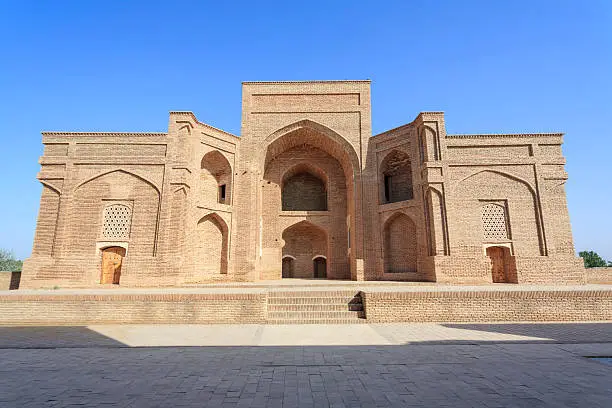
Ferghana Valley
A fertile enclave of 22,000 km² between the Tian Shan and Alay ranges, where ikat silk, blue ceramics and pchak knives are still crafted using 19th-century methods.
The Ferghana Valley occupies a depression of 22,000 km² in eastern Uzbekistan, framed to the north by the Tian Shan ranges and to the south by the foothills of the Alay. It is a fertile enclave watered by the Syr Darya and its tributaries, where nearly a third of Uzbeks live on less than 5% of the nation's territory. To reach it from Tashkent, we take the road that crosses the Kamchik Pass at 2,268 metres, the only road passage between the capital and the valley. The crossing takes five to six hours and marks a sharp change in scenery: the landscape opens onto cotton fields, pomegranate groves, and mulberry trees lined along the roadside.
The valley was long the granary of Central Asia and a crossroads of the Silk Road linking Kashgar to Samarkand. This position shaped a dense artisanal fabric, still active today. In Margilan, the Yodgorlik workshop perpetuates the manufacture of khan-atlas, the silk with flaming patterns obtained by dyeing the warp threads before weaving. We follow every stage: cocoon reeling, skein binding, immersion in indigo or pomegranate baths, loom mounting. The ikat technique has been passed down here since the 19th century. Richtan, 50 kilometres to the east, concentrates around fifty ceramic workshops. The local turquoise-blue colour comes from a mixture of copper oxide and vegetable ash, fired at around 1,000°C. Chust, further north, supplies pchak knives with bone or horn handles, recognisable by their curved blade.
The character of the valley also stems from its human density and religious roots. Andijan, Namangan, Fergana and Kokand together total more than three million inhabitants. Kokand was the capital of an independent khanate until 1876, and the Palace of Khudoyar Khan, built in the 1870s, retains its 70-metre façade covered in polychrome majolica and its 27 still-visitable rooms. Namangan is home to the Mulla Kyrgyz madrasah and the Khoja Amin complex, landmarks of local Sufi practice. Daily life revolves around the bazaars: the Kumtepa bazaar in Margilan, open on Thursdays and Sundays, remains the largest textile market in the region, where buyers from Kyrgyzstan, Tajikistan and China converge.
The cuisine reflects this agricultural density. The valley produces its own varieties of melons and pomegranates, its walnuts, its dried apricots. Local plov, richer and sweeter than in Tashkent, is cooked with quince and raisins. We readily stop travellers at a chaikhana in Fergana to taste chouchvak, small fried dumplings, or norin, noodles cut with a knife served cold with horsemeat. Small family restaurants in Andijan still prepare homemade katyk, fermented yoghurt that you drink or add to soups.
Politically, the valley long remained sensitive and closed to foreigners. International tourism only began there after 2017, explaining the absence of hotel infrastructure comparable to Bukhara or Samarkand. This is precisely what makes the detour worthwhile: you see an Uzbekistan that lives for itself, not for the visitor. Artisans do not recite a formatted speech, bazaars do not stage themselves. Our English-speaking team works with families of artisans in Margilan and Richtan who open their workshops for detailed demonstrations, sometimes lasting half a day.
To discover
Yodgorlik silk workshop in Margilan. Follow the transformation of the cocoon into khan-atlas in the valley's last workshop to produce silk using 19th-century methods, including vegetable dyes and hand looms.
Palace of Khudoyar Khan in Kokand. A 70-metre façade covered in blue and green majolica, the last residence of the khans of Kokand before Russian annexation in 1876.
Kumtepa Bazaar. Textile and ikat market twice weekly in Margilan, frequented by merchants from neighbouring valleys in Kyrgyzstan and Tajikistan.
Richtan ceramicists. Visit family workshops still working with local red clay and copper blue, a heritage of nine centuries of continuous production.
Kamchik Pass. Crossing at 2,268 metres of the only paved road connecting the valley to the rest of the country, with scenic stops on the western Tian Shan foothills.
When to visit
The valley benefits from a marked continental climate. Favourable months are concentrated between April and June and September to October. In spring, daytime temperatures range between 18 and 25°C, orchards blossom in April, mulberry trees leaf in May, when the silk season begins. Autumn brings harvests: pomegranates in September, cotton from October to November, with comfortable temperatures of 20 to 27°C.
We advise against July and August, when the thermometer regularly exceeds 38°C in the valley's cities, the air becomes heavy and artisans often interrupt their firings during the day. Winter, from December to February, remains manageable but cool (0 to 8°C), with the Kamchik Pass sometimes closed for a few hours after snowfall. Rainfall is sparse, concentrated between March and April, without significantly hindering circulation.
Practical tips
Allow three full days for a first visit from Tashkent: one day for crossing the Kamchik Pass and arriving in Kokand with its palace, one day for Fergana, Margilan and its silk workshops, one day for Richtan and the return. With four or five days, add Andijan, birthplace of Babur founder of the Mughal empire, and Namangan for its madrasahs. The entry point is by road from Tashkent, approximately 320 kilometres, or by air via the small airports of Fergana, Andijan and Namangan, served by daily one-hour domestic flights from the capital.
The valley logically combines with Tashkent at the beginning or end of a circuit. It integrates less easily with Samarkand, Bukhara or Khiva, as it requires a round trip through Tashkent. Hotel comfort remains adequate but without luxury: family guesthouses in Margilan and Kokand, standard three-star hotels in Fergana and Andijan. The region suits travellers already familiar with Central Asia or visiting Uzbekistan a second time, textile and ceramic craft enthusiasts, and contemplatives who prefer daily life in an inhabited valley to grand Timurid monuments. Less suited to families with young children for whom the mountain pass road is long.