Narbutabey Medressa
Built under Narbuta-biy in the 18th century, the Narbutabey Medressa stands as one of the few witnesses to Kokand's Islamic educational architecture. Blue-glazed portal, inner courtyard, and authentic atmosphere, far from mass tourism circuits.
The Narbutabey Medressa rises at the heart of Kokand, the former capital of the khanate of the same name. Built in the 18th century under the reign of Narbuta-biy, it ranks among the rare Islamic educational buildings that survived the Soviet era without being entirely transformed. Its fired-brick portal and blue-glazed tile decorations bear witness to the craftsmanship of the Fergana region.
What to See
The medressa follows the classical layout of Central Asian Islamic educational establishments: an inner courtyard surrounded by cells (hujra) where students lived and studied. The entrance portal (pishtaq) is adorned with geometric ceramic motifs. The ensemble is more modest than the grand medresas of Samarkand or Bukhara, yet it retains an authentic atmosphere, far from tourist crowds.
History and Context
Narbuta-biy governed the Kokand khanate in the second half of the 18th century and transformed the city into a political and cultural hub of the Fergana Valley. The medressa he commissioned served to train scholars and religious officials. Kokand once boasted several dozen medresas; the Narbutabey is among the few that survive in recognizable form.
Highlights of Your Visit
The Entrance Portal
The pishtaq concentrates most of the decoration: turquoise-blue faience tiles, geometric interlacing, and calligraphy. It is the best-preserved and most photographed element of the building.
The Inner Courtyard
The courtyard allows you to visualize the layout of a traditional medressa. The two-story cells provide a tangible sense of student life under the khanate.
Etiquette and Visiting Rules
- Dress code: shoulders and knees covered, out of respect for the site's religious character.
- Shoes: remove them if you enter a prayer room or sacred space that is marked.
- Discretion: speak quietly, avoid loud gestures.
Photography Tips
Morning light shines directly on the entrance portal, bringing out the nuances of the blue faience. Frame from the central axis of the courtyard to capture the symmetry of the pishtaq. Ask permission before photographing people present on site.
Location and Access
The Narbutabey Medressa stands in the historic center of Kokand, near the Palace of Khudayar Khan, the city's principal monument. Kokand is accessible from Tashkent by train or road via the Fergana Valley. Shared taxis regularly connect Kokand to Fergana and Andijan.
Nearby Attractions
- Palace of Khudayar Khan — residence of Kokand's last khan, now a regional museum, within a few minutes' walk.
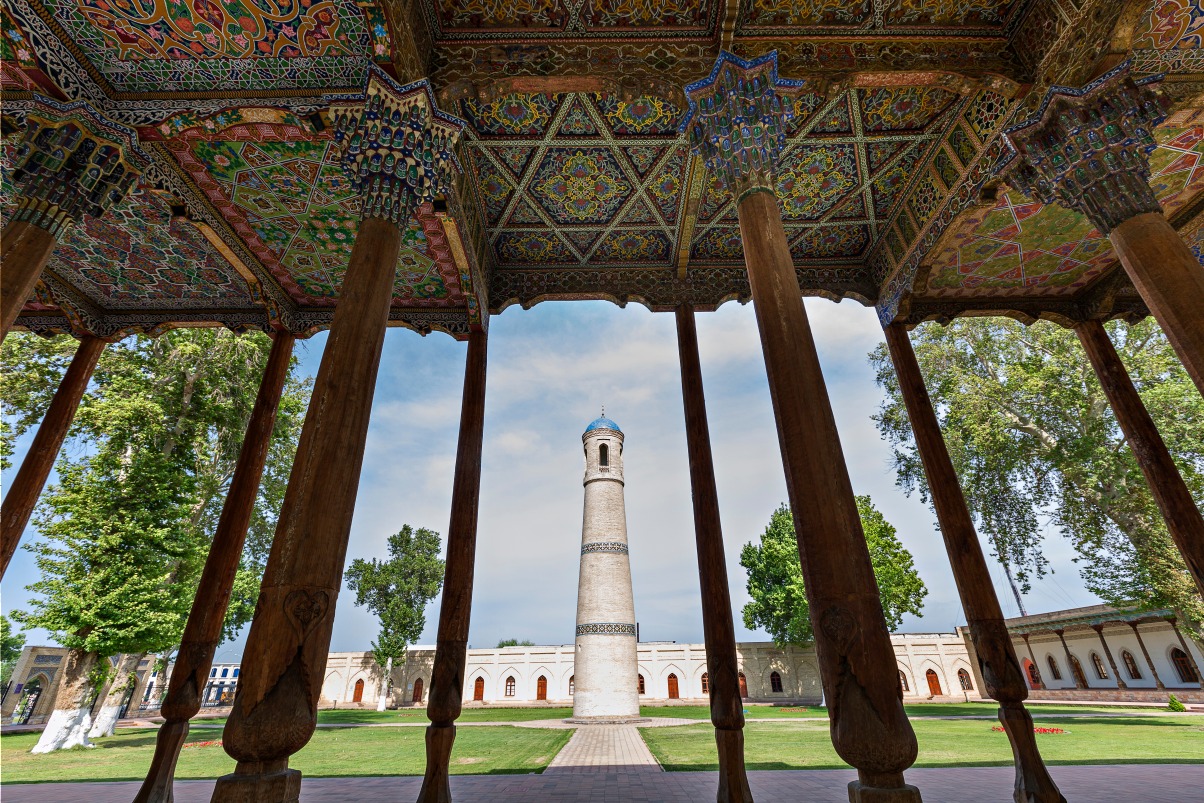
- Jami Mosque of Kokand — grand downtown mosque, remarkable for its carved wooden columns.
- Fergana — regional capital of the valley, a starting point for exploring local craftsmanship and silk workshops.
- Rishtan — village renowned for its traditional pottery with blue and green glazes, about an hour's drive away.
Frequently asked questions
Access may be free or subject to a modest entrance fee depending on the period and restoration status of the site. Have a few Uzbek sums on hand.
Shoulders and knees must be covered. A headscarf for women is recommended. These rules apply to all places of worship in Kokand.
Yes, both sites are close to each other in the historic center. A half-day is sufficient to visit both comfortably.
Spring (April–May) and autumn (September–October) offer pleasant temperatures. Summer in the Fergana Valley is very hot, often exceeding 35 °C.
Wheelchair accessibility is not guaranteed: paved courtyards and thresholds may pose difficulties. Check with your local agency before your visit.
Give it a go!
Our local experts arrange this activity for you.