Bukhara Synagogue
In the heart of Bukhara's old city, the synagogue bears witness to the centuries-long presence of the Bukharan Jewish community, one of the oldest in Central Asia.
In the heart of Bukhara's old city, the synagogue bears witness to the centuries-long presence of the Bukharan Jewish community — one of the oldest in Central Asia. This modest yet active house of worship offers a rare counterpoint to the Islamic architecture that dominates the city. It reminds us that Bukhara was long a crossroads of civilizations and faiths.
Practical Information at a Glance
- Admission: Usually free or voluntary contribution; inquire on-site
- Dress code: Head covering required for men (skullcap provided at the entrance), decent attire for all
- Suggested duration: 20 to 40 minutes
- Language: The community speaks Judeo-Tajik (Bukhori); an English-speaking local guide enhances the visit
What You'll See
The building features modest architecture, blending local influences with Jewish liturgical elements. Inside you'll find a sacred ark (aron ha-kodesh) housing the Torah scrolls, ancient wooden benches, and Hebrew inscriptions. The prayer hall reflects how Jewish tradition adapted to the Central Asian context over centuries.
History and Context
According to community tradition, Bukharan Jews settled in Bukhara more than two millennia ago. Under the Emirate of Bukhara, they lived in a distinct quarter, the Jewish mahalla. The community reached its peak in the 18th and 19th centuries, before massive emigration to Israel, the United States, and Europe in the 20th century drastically reduced its size. Today, only a handful of families remain in Bukhara.
Highlights of the Visit
The Prayer Hall
The liturgical space preserves its period furnishings and contemplative atmosphere. Witnessing a prayer service, should the opportunity arise, is a rare and moving experience.
The Historic Jewish Quarter
Surrounding the synagogue are remnants of the old Jewish mahalla, with its characteristic interior courtyards. Walking through these narrow streets offers insight into how the community was spatially organized.
Etiquette and Visiting Rules
- Cover your head (skullcap available at the entrance for men).
- Wear decent attire: shoulders and knees covered.
- Speak softly, especially if a prayer service is underway.
- Ask permission before photographing community members.
- Respect Shabbat: the synagogue may be closed from Friday evening to Saturday evening.
Photography Tips
Natural light filters gently through the interior in the morning hours. Photograph the sacred ark and Hebrew inscription details with discretion. Avoid flash, which disturbs the sanctuary's atmosphere. The modest exterior lends itself to architectural framing that highlights the façade within its medieval alleyway context.
Location and Access
The synagogue is located in Bukhara's old city, near the central bazaar and the Lyabi-Hauz. The historic center is easily explored on foot; most old city accommodations are within walking distance. An English-speaking local guide familiar with the community facilitates access and deepens understanding of this sacred space.
Nearby Attractions
- Lyabi-Hauz — Bukhara's central basin, surrounded by madrasas and animated teahouses.
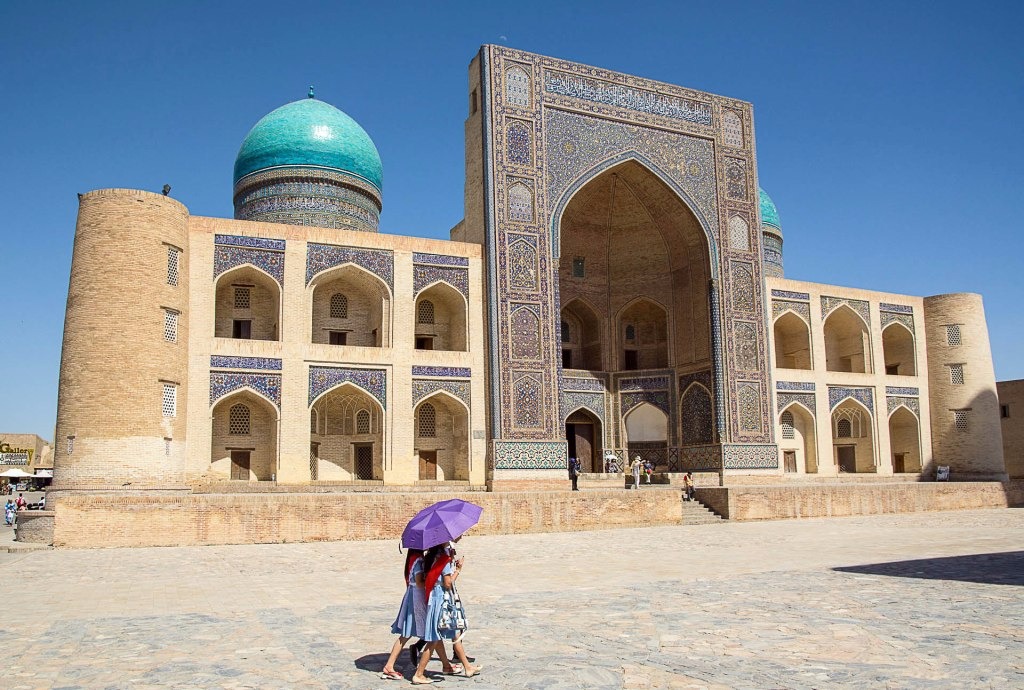
- Madrasa Nadir Divan-Begi — A 17th-century edifice with remarkable mosaic façade ornamentation, bordering the Lyabi-Hauz.
- Ark of Bukhara — Fortress-palace of the emirs, a symbol of the city's historic power.
- Kalon Mosque — Great mosque of the 12th century dominated by the famous Kalon minaret.
Frequently asked questions
Yes, a small Bukharan Jewish community maintains the synagogue as an active place of worship. Services take place, particularly on Shabbat and during Jewish holidays.
Men must cover their heads (skullcap available on-site). All visitors should wear clothing that covers shoulders and knees.
The synagogue may be closed to tourist visits from Friday evening through Saturday evening. Plan your visit on a weekday for more flexibility.
Highly recommended. An English-speaking local guide familiar with the community facilitates your welcome and provides the historical context necessary to fully appreciate the visit.
Yes. The synagogue fits naturally into a half-day exploration of the historic center, with the Lyabi-Hauz, madrasas, and bazaar all within immediate walking distance.
Nearby

Interested in this visit?
We can include it in your personalised itinerary.