Sultan Saodat Ensemble
A dynastic necropolis of the Sayyids of Termez, the Sultan Saodat Ensemble brings together mausoleums, portals and mosques from the 11th to 17th centuries. Chiseled bricks, turquoise domes and carved wooden cenotaphs compose one of the richest funerary complexes in southern Ouzbékistan.
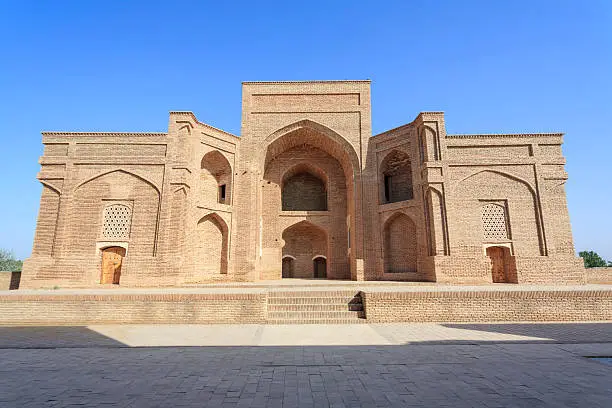
A few kilometers north of Termez, the Sultan Saodat Ensemble groups mausoleums, mosques and funerary portals erected between the 11th and 17th centuries. This complex houses the tombs of the Sayyids of Termez, descendants of the Prophet who marked Islam in Central Asia. The architecture of fired brick, turquoise domes and Kufic epigraphs make it one of the best-preserved funerary ensembles in southern Ouzbékistan.
Practical info at a glance
- Entrance : paid (ticket to settle on site; rate to verify with your local agency)
- Recommended duration : 1 to 1.5 hours
- Dress code : shoulders and knees must be covered; headscarf recommended for women
- Access : car or taxi from Termez city center; no known direct public transport
What to see
The complex is organized around several domed mausoleums built in fired bricks with fine joints. The portals (pishtak) display geometric decorations and Arabic inscriptions. Some funerary chambers preserve carved wooden cenotaphs from the medieval period. A small congregational mosque completes the ensemble, still in use during religious holidays.
History and context
The Sayyids of Termez, a cherif dynasty settled in the region since the 10th century, made this site their dynastic necropolis. The earliest structures date back to the Karakhanid era (11th century). The complex was enlarged under the Timurids and then under the Shaybanids, each period adding a mausoleum or portal. The Mongol destruction of the 13th century spared some of the buildings, which explains the stylistic diversity visible today.
Highlights of the visit
The Karakhanid portal
The oldest part of the complex, dated to the 11th century, features brick worked in relief characteristic of Karakhanid art. The geometric patterns in braiding and epigraphic friezes remain remarkably legible after the centuries.
The Timurid domes
Several mausoleums erected in the 14th-15th centuries display double-drum domes covered with turquoise tiles. Late afternoon light brings out the blue and green nuances of the faience.
The carved wooden cenotaphs
Inside certain chambers, finely chiseled wooden sarcophagi bear witness to the craftsmanship of medieval local artisans. Their preservation in a semi-open space is remarkable.
Etiquette and visiting rules
- Cover shoulders and knees; headscarf advised for women.
- Remove shoes before entering interior funerary chambers.
- Speak in hushed tones: the site remains an active place of pilgrimage.
- Do not touch cenotaphs or faience decorations.
- Ask permission before photographing worshippers at prayer.
Photography tips
The golden light of late afternoon (two hours before sunset) enhances the ochre bricks and turquoise domes. Position yourself facing the main portal to capture the symmetry of the arches. Inside, natural light filtered through the latticework creates chiaroscuro effects on the cenotaphs. Check photography restrictions with the guardian at the entrance.
Location and access
The Sultan Saodat Ensemble is located north of Termez, in the Surxondaryo region, near the Afghan border. The city is accessible by plane from Tashkent or by train. From Termez city center, a taxi or rental vehicle is the most convenient way to reach the site. No regular bus line is confirmed. Accessibility for people with reduced mobility is limited due to earthen floors and high door thresholds.
Nearby
- Kokildor Mosque — historic mosque in Termez city center, representative of local Timurid architecture.
- Termez Archaeological Museum — Buddhist and Greco-Bactrian collections from regional excavations.
- Fayaz Tepe — Buddhist monastery from the 1st-3rd century, one of the best-preserved Buddhist sites in Central Asia.
- Kara Tepe — Buddhist rock complex carved into the cliff, near the Amu Darya.
Interested in this visit?
We can include it in your personalised itinerary.