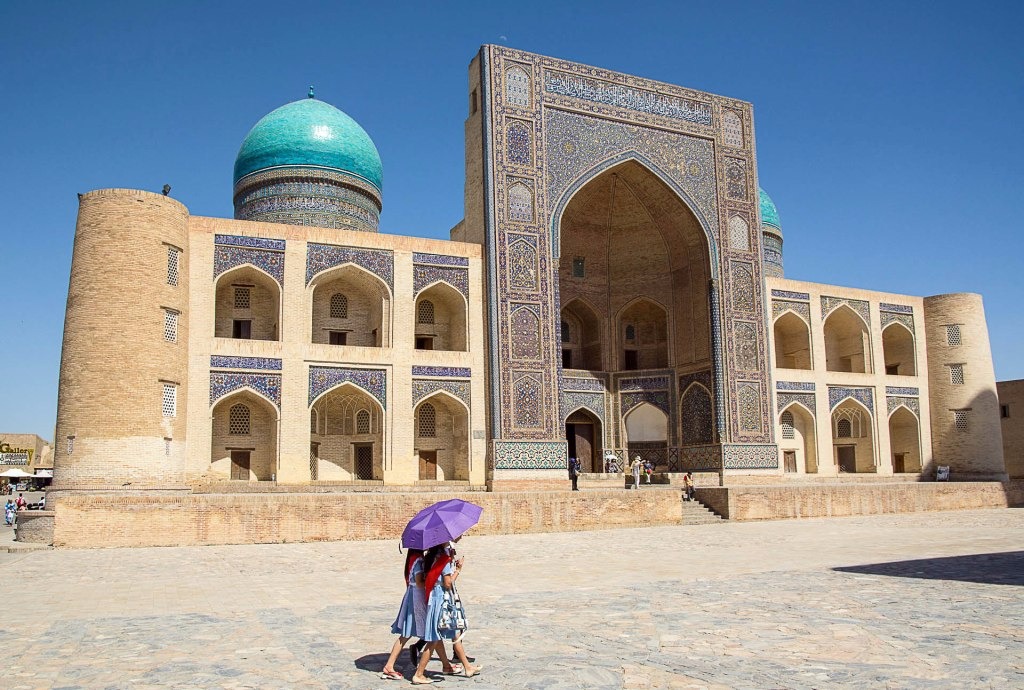
Rabat-i Malik Caravanserai
Built in the 11th century by the Karakhanids, Rabat-i Malik is a partially preserved caravanserai on the route between Bukhara and Samarkand. Its geometric brick portal and reservoir bear witness to the caravan trade of the Silk Road.
Rabat-i Malik is an 11th-century caravanserai erected on the road between Bukhara and Samarkand, in the Kyzylkum steppe. Built under the Karakhanids, it marked a vital stage for caravans crossing this arid zone. Today, only a monumental portal and remnants of the enclosure survive, yet their presence in the desert remains striking.
Practical Information at a Glance
- Access: Located on the main M37 highway (Bukhara–Samarkand), near the village of Karmana, Navoi region
- Transport: Accessible by car or taxi between Bukhara and Samarkand; no direct public transport
- Recommended duration: 20 to 40 minutes — a roadside stop rather than a standalone destination
- Admission: Open-air site, free access to the grounds
What You'll See
The entrance portal, partially restored, is the centerpiece of the site. Its decoration in woven geometric brickwork is characteristic of Karakhanid style. Immediately nearby stand the ruins of a water reservoir (hauz) that supplied travelers. The ensemble gives a concrete sense of the logistical organization of the Silk Road.
History and Context
The caravanserai was commissioned in the 11th century by the Karakhanid ruler Shams al-Mulk Nasr. Its name literally means "royal fortress." It was part of a network of infrastructure designed to secure and monetize commerce between Central Asia and the Islamic west. The Karakhanids, the first Turkish rulers to convert to Islam, left few monuments as well preserved as this one.
Highlights of Your Visit
The Karakhanid Portal
The fired-brick façade presents relief decoration of lozenges and geometric plaits, without glazed tiles — a sober and powerful aesthetic characteristic of the 11th century. The entrance arch, tall and slightly pointed, frames the steppe sky.
The Hauz (Reservoir)
The adjacent rectangular basin, now dry, reminds us that water was the most precious resource on this route. Its size testifies to the volume of traffic the site must have accommodated at its height.
Photography Tips
Raking morning or late afternoon light brings out the relief of the brick decoration. Photograph the portal from a slightly oblique angle to capture the depth of the arch. The flat steppe horizon provides an effective minimalist frame in wide angle.
Location and Access
Rabat-i Malik stands roughly midway between Bukhara and Samarkand, on the M37 highway, near Karmana. Most travelers stop here during a vehicle transfer between the two cities. No tourist infrastructure (equipped parking, restrooms, shops) is guaranteed on-site.
Nearby
- The Registan, Samarkand — an ensemble of three 15th–17th century madrasahs, symbol of Timurid architecture.
- Kalon Mosque, Bukhara — a 12th-century mosque centered on the famous Kalon minaret.
- Ark of Bukhara — an ancient citadel in the heart of Bukhara's old city.
Frequently asked questions
It is best visited en route between Samarkand and Bukhara. A special detour from either city is rarely justified for this site alone.
No, it is not an active place of worship. Comfortable clothing suited to the steppe heat is sufficient.
There is generally no permanent guide on the site. Plan to bring your own documentation or travel with a private guide from Samarkand or Bukhara.
Spring (April–May) and autumn (September–October) offer pleasant temperatures. Summer in the steppe can be very hot.
Yes, the stop integrates naturally into a Bukhara–Samarkand itinerary by car, with a possible halt in Karmana or Navoi.
Interested in this visit?
We can include it in your personalised itinerary.